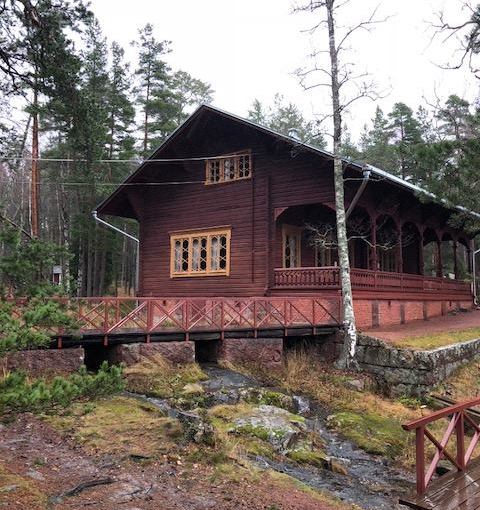
The natural beauty and fishfilled rapids of Langinkoski have always facinated visitors. Even Alexander III, the Emperor of Russia and Grand Duke of Finland, liked to spend time here. His fishing lodge still stands at the rapids. The unique combination of the beautiful landscape and imperial buildings were placed under protection in 1960 with the formation of the Langinkoski Nature Reserve.
The 28-hectare nature reserve owned by the State is part of the Kotka National Urban Park established in 2014. The vegetation in the area ranges from herb-rich forests and black alder swamps on flooded shores to pine stands on rocky areas. Part of the area has been preserved untouched. The cultural environment around the fishing lodge is maintained so as to preserve the atmosphere of the past. Langinkoski is home to a centuries-long fishing tradition. Today, Langinkoski is a popular recreational fishing area for fly fishermen.
In 1880, the Russian crown prince- later to become Emperor Alexander III- visited Kymenlaakso and fell in love with the salmon fishing at Langinkoski. At his request, the Grand Duchy of Finland constructed a sishing lodge for him. Architect Magnus Schjerfbeck prepared the drawings, and architect Johan JacobAhrenberg was in charge of interior design, while Sebastian Gripenberg approved the whole project. The fishing lodge was inaugurated in a grand ceremony in July 1889. At the fishing lodge, The Imperial family members were free from the formalities of the court in St. Petersburg. The Emperor used to chop wood, watch the work of fishermen, and fish himself. The Empress liked to prepare salmon soup for the family.
CHAPEL
The oldest building in the Langinkoskin area is the small chapel of tšasouna. It was built by monks in the early 19th century, when the fishing rights on the rapids were held by the Valaam Orthodox Monastery. The chapel originally had no walls, but walls with windows were added later. At the beginning of the fishing season in the spring the monks blessed the fishing waters at the chapel.
During the construction of the fishing lodge in the late 19th century, the chapel was refurbished for the imperial family. After the imperial visits ended, the chapel was no longer used for religious purposes. Since the 1970´s, the Orthodox parish of Kotka has held services and prayers at the chapel in the summer.


EMPEROR`S FISHING ROCK
When the imperial family visited Langinkoski in July 1888, construction work on the fishing lodge was already underway. The Emperor was seeking a suitable place for fishing and found a large rock he liked at the river. The Emperor is sayed to have built a wooden ladder to the large rock which survived until the 1930´s. From his fishing rock, the Emperor used to angle for large asp, which came to the rapids to spawn.
FISHING IN LANGINKOSKI RAPIDS
From the dayes of Alexander III to the First World War, three fishermen came to Langinkoski from Russia every year. A small cottage was built for them. The Emperor´s fishermen stayed here from mid- May to the end of September.
Salmon fishing began around Midsummer, when larger salmon returned to the river Kymi. Salmon were sometimes caught with a cast net and placed in a pound from which they were scooped with a hand net an then clubbed. The Emperor sometimes angled for salmon from the pound and the Empress did the cooking.
Salmon caught were placed on ice in the cellar overnight, transported by horse to the railway station of Kotka in the morning and from there by train to the fish markets in St. Petersburg. The same places were also used for catching whitefish, which returned to the river in late summer. In August, the fishermen used traps to catch lamprey which are active at night.
The largest annual catches have amounted to thousands of kilos. The long fishing traditions involve lampery as well as salmon and whitefish. Caught in Langinkoski Rapids in September 1891, the largest Atlantic Salmon on record weighed 35 kilos.
THE FISH HATCHERY
The Langinkoski fish hatchery was initially established in 1908 to secure the preservation of salmon and whitefish populations in the River Kymi. Another aim was to acquire funds for the maintenance of the imperial Fishing Lodge and its surroundings.
A system of pipes was used to run water from the river through the incubators. Salmon eggs were incubated in flat trays and whitefish eggs in funnels. The young fish were released into the the river. According to records made in 1912, a total of 52 433 salmon and 57 100 whitefish were released into the River Kymi an Langinkoski that year.


After Alexander III, Langinkoski was rarely visited by members of the imperial family. During the First World War, the fishing lodge served as convalescent home for wounded Russian soldiers. When Finland became independent in 1917, the fishing lodge fell into decay. In the 1920´s it was even proposed that the lodge be demolished. Yet, it was saved by the Kymenlaakso Museum Society which opened the lodge as a museum to the public in 1933. Many items had been removed from the lodge during the first years of independence, but considerable proportion of them have been returned to the museum.
/Texts from Langinkoski museum/ Personal pictures/

